
What is a Good Employee Satisfaction Index?
What is a Good Employee Satisfaction Index?
The Employee Satisfaction Index (ESI) is a critical metric used by organizations to measure and assess the overall satisfaction levels of their employees. It serves as a valuable tool for understanding the health of the workplace environment, identifying areas for improvement, and driving initiatives to enhance employee satisfaction and engagement. However, determining what constitutes a “good” ESI can be complex and depends on various factors specific to each organization. Let’s explore the key considerations for evaluating and interpreting the Employee Satisfaction Index:
1) Definition and Components of ESI:
The Employee Satisfaction Index is a composite measure that evaluates employees’ perceptions and attitudes towards their work, workplace, and employer. It typically encompasses various aspects of the employee experience, including but not limited to:
a) Job satisfaction: Employees’ contentment with their roles, responsibilities, and day-to-day tasks.
b) Work environment: The physical, social, and cultural aspects of the workplace, including safety, facilities, and company culture.
c) Leadership and management: Employees’ trust and confidence in organizational leadership, management effectiveness, and communication.
d) Compensation and benefits: Employees’ satisfaction with their pay, benefits, and overall compensation package.
e) Career development opportunities: Employees’ perception of growth opportunities, training programs, and career advancement prospects within the organization.
2) Benchmarking and Industry Norms:
Evaluating ESI involves benchmarking against industry standards and norms to gain context and perspective. While there is no universally accepted threshold for what constitutes a “good” ESI, organizations may compare their scores to industry averages or benchmarks to assess their relative performance. However, it’s essential to consider factors such as industry type, company size, and geographic location when benchmarking ESI, as these variables can influence satisfaction levels.
3) Trends and Patterns:
Rather than focusing solely on a single ESI score, organizations should analyze trends and patterns over time to gauge progress and identify areas of improvement. Tracking changes in ESI scores across different departments, teams, or demographic groups can provide valuable insights into the effectiveness of organizational initiatives and interventions. For example, a steady increase in ESI scores over several quarters may indicate that employee satisfaction initiatives are yielding positive results, while a decline may signal emerging issues that require attention.
4) Employee Feedback and Perception:
While quantitative ESI metrics are important, qualitative employee feedback and perceptions also play a crucial role in assessing satisfaction levels. Conducting employee surveys, focus groups, or one-on-one interviews can provide deeper insights into the underlying factors influencing ESI scores. Employees’ perceptions of their work environment, job satisfaction, career opportunities, and relationship with management can offer valuable context for interpreting ESI data and guiding strategic decision-making.
5) Impact on Organizational Outcomes:
Ultimately, the effectiveness of ESI lies in its ability to drive positive organizational outcomes. A “good” ESI correlates with improved performance, productivity, retention, and overall organizational success. Organizations with higher ESI scores tend to have more engaged, motivated, and loyal employees, leading to better customer satisfaction, innovation, and financial performance. Therefore, evaluating the impact of ESI on key organizational metrics and outcomes is crucial for assessing its effectiveness and value.
6) Continuous Improvement and Actionable Insights:
Regardless of the absolute value of ESI scores, the goal for organizations is continuous improvement and actionable insights. A “good” ESI catalyzes organizational change and drives initiatives to enhance the employee experience. By identifying areas for improvement and taking targeted actions based on ESI data and feedback, organizations can create a positive work environment where employees feel valued, supported, and motivated to contribute their best.
While there is no one-size-fits-all answer to what constitutes a “good” Employee Satisfaction Index, organizations can assess the effectiveness of ESI by considering factors such as benchmarking, trends over time, employee feedback, impact on organizational outcomes, and the ability to drive continuous improvement. By leveraging ESI as a strategic tool for measuring and enhancing employee satisfaction and engagement, organizations can foster a positive workplace culture and drive organizational success.
Explore Creative Social Intranet
Boost Understanding with Quick Answers
Our Latest Intranet News and Articles
How Digital Workplace Solutions Improve Internal Communication in India?
Introduction In today’s fast-paced corporate environment, organizations across India are increasingly adopting digital tools to improve collaboration and communication. As companies grow and teams become more distributed, traditional communication methods such as emails, scattered chats, and manual updates often lead to confusion, delays, and disengaged employees. This is where a digital workplace solution India becomes essential. A modern digital workplace connects employees, information, and business tools on a single platform, enabling organizations to streamline internal communication and enhance productivity. For Indian enterprises navigating hybrid work environments and geographically dispersed teams, implementing the right enterprise intranet platform India, internal communication software … How Digital Workplace Solutions Improve Internal Communication in India?

How AI-Powered Mobile Apps Are Transforming Internal Communication?
In today’s fast-paced digital workplace, effective internal communication is more important than ever. Organizations with distributed teams, remote workers, and multiple departments need tools that allow information to flow quickly and clearly. Traditional communication methods, such as email, static portals, and disparate messaging tools, often lead to confusion and information overload. This is where AI-powered mobile applications, combined with platforms like Creative Social Intranet, are changing the way companies communicate internally. These smart digital solutions make communication faster, more personalized, and easier to manage across the entire organization. A Creative Social Intranet powered by AI-driven mobile apps enables employees to … How AI-Powered Mobile Apps Are Transforming Internal Communication?
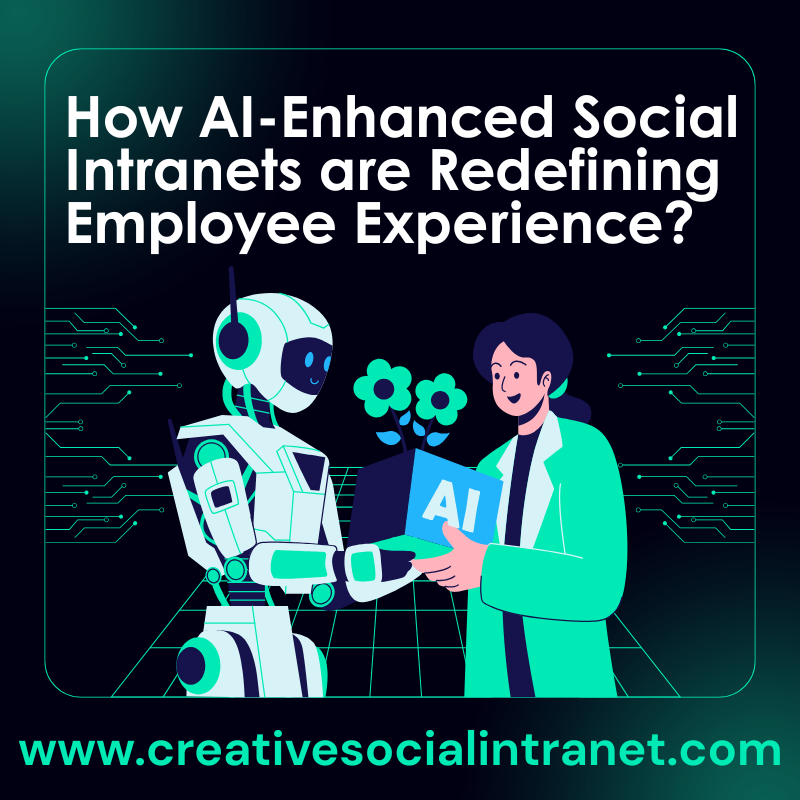
How AI-Enhanced Social Intranets are Redefining Employee Experience?
The modern workplace is undergoing a profound transformation. Hybrid teams, fully remote roles, distributed global workforces, and digital-first communication are no longer trends—they are the new standard. As organizations adapt to this shift, the tools they use must evolve as well. Traditional intranet systems, once designed as simple digital notice boards for announcements and policy documents, are no longer capable of supporting today’s fast-moving, experience-driven workforce. Employees now expect speed, personalization, intuitive navigation, seamless collaboration, and real-time access to knowledge. This is where an AI-powered intranet software, Creative Social Intranet, is revolutionizing the employee experience. By blending artificial intelligence with … How AI-Enhanced Social Intranets are Redefining Employee Experience?